SEO
Google's E-E-A-T: a complete guide


From E-A-T to E-E-A-T
E-E-A-T or double-E-A-T are the four pillars in the algorithm that Google uses to show users the most relevant search results and reliable information. E-A-T has been a principle in the online marketing world for some time; Google added it in 2014 to the Search Quality Guidelines . Last December, Google revised these Guidelines and introduced many changes.
The guide, which explains how Google determines the quality of websites, has been expanded with additional examples and relevant information to rank better. This is also where the new ‘E’ in E-A-T comes into play. We can conclude from these changes that the reliability and quality of content will continue to become more important and have a significant influence on positions in the SERP. That is why we are happy to explain it to you, with examples and a checklist.

What does the principle involve?
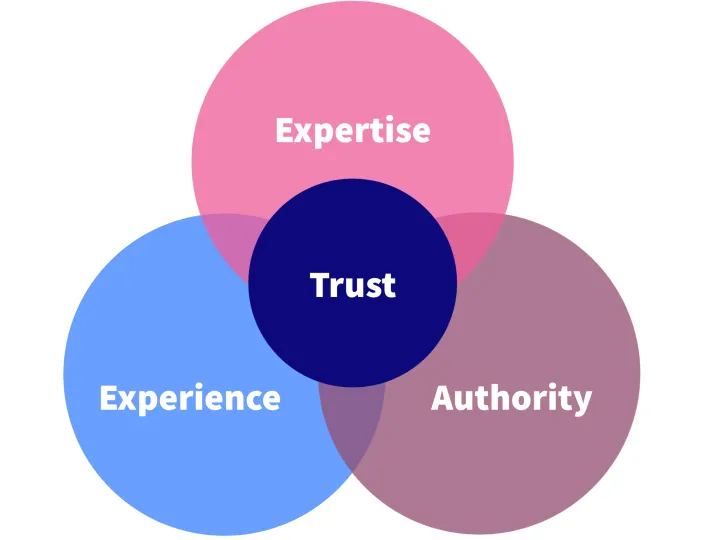
Google uses the E-E-A-T principle to assess whether a website provides users with relevant, high-quality and reliable content. This enables Google to show a searching user the right search result, thereby helping them achieve their goal. E-E-A-T stands for:
- Expertise
- Experience
- Authoritativeness
- Trustworthiness
EEAT explained
Expertise
Expertise means that the content has been written by an expert with extensive knowledge of the subject. When text is written by an expert, this makes the content appear reliable. Consider a blog page about the latest fashion trends, written by an employee of a clothing shop or a fashion designer.
Experience
Experience is fairly self-explanatory: the content has been written by an author who has some form of experience and affinity with the product or service. For example, consider a restaurant review written by someone who has actually visited the restaurant. This makes the review more reliable and therefore more relevant to a searching user.
Authoritativeness
Authoritativeness means that a website is an authority within a particular field, which comes about through receiving external backlinks. Google sees links from other relevant sites to your page as an important signal that your page is valuable. For example, consider a backlink from a news article or relevant website, where your blog page has been used as a source to share relevant information.
Trustworthiness
Trustworthiness is the most important aspect of E-E-A-T. Experience, expertise and authoritativeness support the reliability of a website. If a website is unreliable, it automatically receives a low E-E-A-T score and therefore lower positions in the search results, regardless of how knowledgeable, experienced or authoritative it is. A reliable website, in combination with the other three pillars, will therefore have the desired effect on rankings.
The difference between expertise and experience
The line between expertise and experience is fairly thin, as someone with knowledge of a product or service often also has experience with it. Nevertheless, there is a difference. Expertise concerns objective knowledge or skills that are verifiable and accurate. Experience is often subjective and concerns people’s opinions. This is often shared through a personal story or experience.
Is E-E-A-T a ranking factor?
The above pillars are not a direct ranking factor. However, they do indirectly influence the performance of a website. If you meet these pillars, Google sees your website as valuable and you will appear in the search results more quickly. In addition, the quality of content has of course been important for performing well in the SERP for years, and the E-E-A-T principle enables high-quality content to be assessed even more effectively.
How does Google assess these pillars?
Google assesses the quality of a page (PQ rating) based on the following scale:
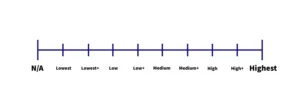
This takes the purpose of a website or page into account. If a page is misleading or could cause harm, this is considered the lowest possible PQ rating. Google therefore looks at how a page achieves its purpose to determine whether it is user-friendly.
The most important factor with the greatest influence on page quality is the ‘Main Content’. Google sees this as the content on the page that directly influences the communication of the purpose of that specific page. In addition to text, ‘Main Content’ also includes images, videos and audio (such as a podcast).
By writing good, clear and original content that has had time and effort invested in it, you can communicate your expertise more effectively and Google will therefore give your page a higher rating on the above scale.
E-E-A-T and AI
Today, content has a new leading role, with a major effect on the online content landscape: AI. ChatGPT and other language models can produce texts at record speed, and nowadays there are few people who do not use them. However, AI models are not copywriters but generative prediction models. What does that mean? They generate their texts based on all the content already available on the internet, and the output is a prediction of what you, as a user, probably want to see. This has several consequences:
- The content is never unique, as it is based on all the content available somewhere on the internet.
- The output lacks real experience and tangible examples that demonstrate expertise.
- They also lack human nuance, for example in persuasiveness, puns and other things that make a text appealing.
- The texts also often remain superficial and lack genuine depth.
Logically, this affects the unique value and helpfulness of a text for a user, which is an important factor for Google in determining whether or not a page will appear high in the search results. Google itself writes extensively about the use of AI in content and says the following: ‘When it comes to automatically generated content, our guidance has been consistent for years. Using automation, including AI, to generate content with the primary purpose of manipulating ranking in search results is a violation of our spam policies‘ (source ).
Does this mean that AI is completely useless when it comes to meeting the E-E-A-T principle? Certainly not.
What does Google say?
In fact, AI can absolutely contribute to the creation of high-quality content, provided it is used in the right way. In that same article, Google also says: ‘Appropriate use of AI or automation is not against our guidelines. (…) Our focus on the quality of content, rather than how content is produced, is a useful guide that has helped us deliver reliable, high quality results to users for years.’ (source ). In short: Google does not penalise the use of AI. In fact, it encourages the creation of high-quality content, regardless of the tools used. As long as the E-E-A-T principle is satisfied, it does not matter whether AI is used. If you want to meet the E-E-A-T principle and use AI, consider the following points:
- Always check the information provided by AI, for example by asking for sources. You may also include a source citation on the website itself.
- Always supplement the content yourself, for example with your own experience and elements such as tables and images.
- Make the content concrete: AI tends to be superficial, so supplement it with concrete examples and explanations.
- Good prompts: experiment with prompts and use clear instructions to get as much as possible from AI.
How can you meet the E-E-A-T guidelines?
There are various matters or elements you can add to optimise your content for these principles. Here are some possibilities!
‘About us’ page
When assessing page quality, Google also considers what a website or the author of an article says about themselves. This can be communicated through an ‘About us’ page. To make this as complete as possible, Google indicates that the page should cover the history of a company, who its founders are and what service and quality they provide. This can help determine whether the author or owner of a website is a reliable source.
The quality of content
The quality of content is important for communicating the purpose of a page. Google considers the level of effort, originality, talent and accuracy of content. By actively investing time and effort in writing a text or creating a video or podcast, Google will consider your content original and unique. Accuracy is particularly important for informative pages, where it is relevant that the content is factually correct.
Images, tables and lists
A good way to demonstrate that effort and originality have gone into a blog is to use original images, tables and lists. This also makes a text easier to read, which indirectly influences the user-friendliness of a page. It can also help you convey your knowledge and expertise more effectively. When using images, it is important that they are original images.
Author and source attribution
Stating the author of an article or blog page is a useful way to convey expertise and trustworthiness. This makes it clear to a visitor what level of knowledge the author of an article has. Citing sources also confirms to the search engine that the information in a blog or article has been researched and is based on facts. This therefore contributes to trustworthiness and strengthens your expertise.


Communicating trustworthiness as an online shop
As an online shop, it is very important that visitors can trust your website. According to the Search Quality Guidelines, you can incorporate the following aspects into your website to convey trustworthiness:
- Reliable payment methods: as a user, you want to be certain that you can make a payment safely with an online shop. Google thinks the same way. By communicating your payment methods clearly on the website, you appear more trustworthy.
- Contact page and easily accessible customer service: a contact page makes it easier for users to get in touch. It is also essential for an online shop to have easily accessible customer service, so that a user can ask a question directly.
- Information about shipping and returns: this information is also relevant to a user and is therefore important to include on the website.
- Reviews at company and product level: reviews influence a website's reputation. Reviews are based on the experience users have with an online shop and its products. Product reviews help other users make an informed choice when making a purchase. They therefore provide a good indication of a website's trustworthiness.
Checklist for E-E-A-T optimisation
The checklist below summarises the E-E-A-T story. You can use this checklist to check whether there are still opportunities within your website to optimise further, so that your website is E-E-A-T-worthy.
'About us' page
A clear ‘about us’ page containing information about your company and its employees.
Reviews
Communicate reviews clearly on your website, both at company and product level.
Customer service
Make sure that visitors can easily get in touch. Also communicate information about shipping and returns clearly.
Payment methods
Clearly communicate the payment methods you use as an online shop on the website.
Original content
Make content original and accurate by investing time and effort in it, allowing your talent to shine through.
Source citations
Make your content factually reliable by including source citations in the text.
Author
Demonstrate your expertise by naming the author of the blog and, where applicable, providing background information.
Content elements
Use original images, tables and lists to make your content easy to read and convey originality.
UNCOVER YOUR VISIBILITY POTENTIAL NOW!
\n Discover your potential\n \n \n Challenge us\n \n


\ Free visibility check
Discover your organic potential
Curious how you compare in your industry? Our experts will analyse your online position for free.
Request a free scan