Brand analyses
Two years of BIYÙ: brand search demand almost triples

How does search demand change as a young beauty brand becomes better known? The supplied BIYÙ analysis shows a clear movement: from 89,590 to 243,040 branded searches across the Netherlands and Belgium. That is approximately 171% growth. The mix also shifts towards the brand name and products rather than the founder.
This is an editorial analysis of search behaviour, not a verified client case study. The figures do not prove that Aspen Digital caused this growth. The report is dated November 2026 and measurement data runs through September 2026. The article publication date is separate.
The analysis follows 113 search terms from Google suggestions in both countries: 40 have measurable volume and 73 do not. Keyword Planner rounds these volumes. This shows the development of search interest, not revenue, website visits or unique people.
Brand search demand almost triples over twelve months
BIYÙ launched in November 2024. However, the first comparison period begins in October 2024 and ends in September 2025. The second runs from October 2025 through September 2026. These are equal periods, not calendar years or exactly two years from launch day.
- First period
- 89,590
- Second period
- 243,040
- Growth, rounded
- +171%
The Netherlands grows from 78,610 to 209,750 searches, approximately 167%. Belgium moves from 10,980 to 33,290, approximately 203%. The Netherlands remains the larger market; Belgium grows faster in relative terms and represents about 14% of the second period’s total.
- Oct 2024 to Sep 2025
- Oct 2025 to Sep 2026
Linear scale starting at zero. Netherlands and Belgium combined unless stated otherwise. Source: supplied BIYÙ analysis, November 2026.
| Market | Oct 2024 to Sep 2025 | Oct 2025 to Sep 2026 |
|---|---|---|
| Netherlands | 78,610 | 209,750 |
| Belgium | 10,980 | 33,290 |
| Total | 89,590 | 243,040 |
The 2026 interim result is a different comparison
For January through September, 60,050 searches in 2025 compare with 198,270 in 2026. That is approximately 230% growth. This is explicitly not a full-year total for 2026. October, November and December 2026 are absent from this export.
The baseline includes quieter months shortly after launch. Part of the difference may therefore reflect a brand becoming better known. The strong year-end months are still missing from the interim result. In this same nine-month comparison, hair grows from 1,850 to 21,080 searches; do not confuse these figures with the twelve-month total below.
The interim result is strong in both markets: the Netherlands grows by approximately 228% over these nine months and Belgium by approximately 248%. Every theme with measurable volume grows. At 25,740 searches, September 2026 is almost three times September 2025. In seven of the first nine months of 2026, total demand also exceeds the November 2024 launch peak of 14,860 searches.
From “bi yu” to “biyu”
The two leading name variants generate 188,140 searches together in the second period. “biyu” grows from 37,110 to 136,780, about 269%. “bi yu” increases from 32,790 to 51,360, about 57%. The single-word spelling’s share within these two name terms rises from approximately 53% to 73%.
This is consistent with a spelling becoming established, but is not a direct study of brand recognition. The “core brand” theme is slightly broader than these two terms, at 188,840. These totals should not be treated as interchangeable.
The shift matters for how the brand is presented recognisably. In the first period the two spellings are close: around 53% without a space and 47% with one. In the second period this becomes 73% versus 27%. One spelling clearly gains weight, while the spaced variant also continues to grow in absolute terms.
Not every search for “biyu” can be attributed to the beauty brand with certainty. The term already had between 1,000 and 2,900 Dutch searches per month in 2023 and early 2024, before launch. Other meanings or spellings may continue to contribute to later figures.
- Oct 2024 to Sep 2025
- Oct 2025 to Sep 2026
The 12 terms with the highest volume in the second period, not the full selection of 113 terms. Original search terms are unchanged. Linear scale starting at zero. Netherlands and Belgium combined unless stated otherwise. Source: supplied BIYÙ analysis, November 2026.
View the data
| Search term | Oct 2024 to Sep 2025 | Oct 2025 to Sep 2026 |
|---|---|---|
| biyu | 37,110 | 136,780 |
| bi yu | 32,790 | 51,360 |
| biyu jade anna | 10,300 | 12,190 |
| biyu borstel | 230 | 7,990 |
| biyu heatless curls | 500 | 7,040 |
| bi yu jade anna | 4,760 | 5,370 |
| bi yu heatless curls | 590 | 3,220 |
| biyu setting spray | 0 | 2,300 |
| bi yu borstel | 130 | 2,250 |
| biyu haarborstel | 0 | 2,100 |
| biyu eye patches | 0 | 1,290 |
| jade anna merk | 760 | 1,220 |
The name drives the total, products change the mix
More than three quarters of second-period demand falls within the core brand theme. It accounts for 188,840 searches, 77.7% of the total, and grows by approximately 168% according to the report. Most volume therefore still comes from people searching for the name rather than individual products.
| Theme | Searches | Share |
|---|---|---|
| Core brand | 188,840 | 77.7% |
| Hair | 24,780 | 10.2% |
| Jade Anna | 20,440 | 8.4% |
| Beauty and make-up | 4,790 | 2.0% |
| Skin and body | 2,270 | 0.9% |
| Service and trust | 1,160 | 0.5% |
| Bundles and gifts | 760 | 0.3% |
The distribution becomes more interesting below that headline. Hair is the largest product category at 24,780 searches. Beauty and make-up grows from 110 to 4,790. Skin and body reaches 2,270, service and trust 1,160, and bundles and gifts 760. These smaller themes have less impact on the total but show demand extending beyond the name and founder.
Questions about shops and retailers have no measurable volume in the selection. The report relates this to a brand selling online. This does not prove nobody searches for physical stockists: Keyword Planner may show no measurable volume particularly for small counts.
Hair products give the growth more substance
The hair theme grows from 1,850 to 24,780 searches across the two twelve-month periods, approximately 1,240%. Hair accounts for 10.2% of the second period. Brush variants, including “biyu borstel” and “biyu haarborstel”, rise together from 360 to 12,500. Heatless curls reaches 10,790.
Product language varies: people use Dutch words for brushes alongside English product names such as “heatless curls” and “eye patches”. The individual term “biyu setting spray” appears with 2,300 searches in the second period; “biyu eye patches” with 1,290. Zero in the first period means no measurable volume in the source, not proven absence of interest.
Brushes overtake heatless curls
In the source, the hair theme initially centres on heatless curls. Brush variants gain weight later. “biyu borstel”, “bi yu borstel”, “biyu haarborstel” and the set together reach 12,500 searches, slightly above the 10,790 for heatless curls. The English “brush set” remains smaller at 690. Dutch product language therefore dominates brushes, while the English name is common for heatless curls.
The timing differs too. In February 2026, “biyu borstel” jumps to 1,300 searches in the Netherlands in one month. “biyu heatless curls” reaches 2,400 there in September. The overall hair theme across both countries rises from 1,020 in January 2026 to 3,060 in February and reaches 4,760 in September. Different product movements sit behind the annual growth.
Beauty and skin appear later in search demand
Beauty and make-up initially remains small, then accelerates in summer 2026: from 190 searches in May to 930 in June, 1,190 in July and 1,430 in August. September records 500. The setting spray fits this movement. Skin and body also becomes clearly visible later, with 330 searches in May and 570 in September, including questions about eye patches.
Products becoming measurable later raises an interesting question about introductions and awareness. It does not establish exactly when a product launched or which campaign caused the interest. The brand’s product and content calendar would be needed for that.
What grew fastest and what declined?
Percentages and counts tell different stories. “biyu” adds 99,670 searches and “bi yu” 18,570. Outside these two name terms, “biyu borstel” is the largest riser with 7,760 additional searches. Next are “biyu heatless curls” with 6,540 and “bi yu heatless curls” with 2,630.
“biyu setting spray” adds 2,300, “bi yu borstel” 2,120 and “biyu haarborstel” 2,100. Growth in “biyu jade anna”, at around 18%, is less spectacular but still adds 1,890 searches. That exceeds the additional 1,290 for “biyu eye patches” or 920 for “biyu bonnet”. “biyu kortingscode” adds 720. Looking only at percentage growth would understate the importance of larger established terms.
| Search term | Oct 2024 to Sep 2025 | Oct 2025 to Sep 2026 |
|---|---|---|
| biyu nl | 420 | 250 |
| biyu jade anna website | 200 | 160 |
Among terms with at least 100 searches in either period, only two decline: “biyu nl” from 420 to 250, approximately 40%, and “biyu jade anna website” from 200 to 160, 20%. Both are small terms used to find the website. People may add “nl” or “website” less often as the name becomes familiar. Direct visits or other routes to the shop could also play a role. Search volume cannot distinguish between these explanations.
Jade Anna: a smaller share, more absolute searches
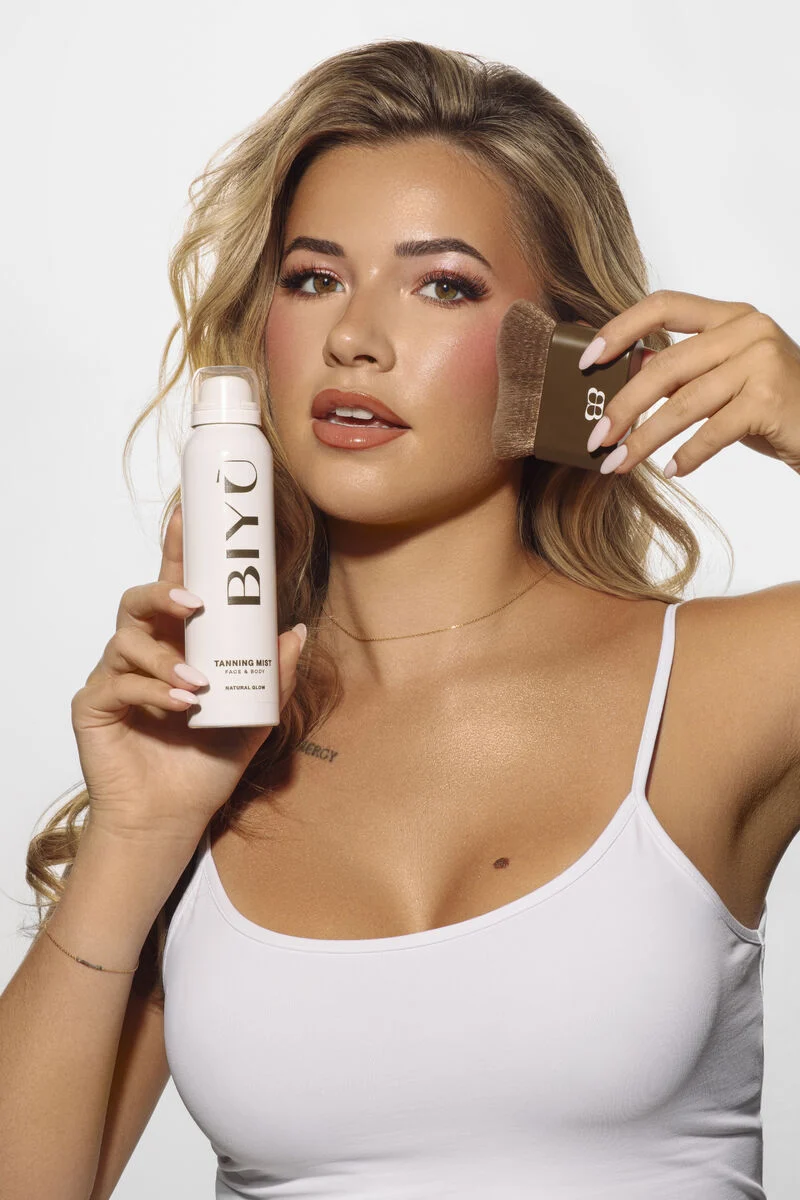
The Jade Anna theme’s relative share falls from around 19% to 8.4%, because other branded searches grow faster. Absolute search demand around Jade Anna actually rises by approximately 21% to 20,440. It would therefore be incorrect to say demand for her declined.
A brand searched for more often independently is one possible explanation, not a proven conclusion. The report gives Belgium a share of approximately 13% for this theme, compared with about 8% in the Netherlands. Different stages of awareness, product interest or channel use could play a role; this search data cannot distinguish between them.
The founder is not disappearing from search demand. The brand mainly grows faster outside explicit references to her. This could fit a more independent brand name, but also steadier reach for her content alongside growth in other channels. Searches without her name may still follow an introduction through her.
The Netherlands and Belgium show different profiles
Belgium grows faster in percentage terms over the twelve-month comparison, but the Netherlands remains by far the larger market in absolute terms. The Dutch increase is 131,140 searches; Belgium adds 22,310. Faster percentage growth in a smaller market is not the same as the largest contribution to overall growth.
The mix differs too. In Belgium, the Jade Anna theme represents around 13% of brand demand, against approximately 8% in the Netherlands. The theme grows by approximately 103% there, compared with approximately 8% in the Netherlands. Hair products, in contrast, represent around 5% of Belgian demand and 11% of Dutch demand.
This could fit a Belgian audience still discovering the brand more through the founder, while product names are searched for independently more often in the Netherlands. Different channel use or product awareness could also explain it. The figures justify examining the markets separately, not automatically choosing the same approach or a separate introduction budget.
A higher baseline with recognisable peaks
November and December are strong in both comparison years. The first coincides with launch; the second with Black Friday and the festive season. July 2025 also stands out at 14,530 searches, as does June 2026 at 31,420. Coincidence is not proof that these events caused the demand.
- Oct 2024 to Sep 2025
- Oct 2025 to Sep 2026
Months are aligned by comparison year. October refers to 2024 and 2025; January through September to 2025 and 2026. Linear scale starting at zero. Netherlands and Belgium combined unless stated otherwise. Source: supplied BIYÙ analysis, November 2026.
View the data
| Month | Oct 2024 to Sep 2025 | Oct 2025 to Sep 2026 |
|---|---|---|
| Oct | 370 | 8,790 |
| Nov | 14,860 | 19,060 |
| Dec | 14,310 | 16,920 |
| Jan | 6,990 | 14,230 |
| Feb | 2,490 | 20,870 |
| Mar | 4,610 | 18,910 |
| Apr | 2,970 | 12,510 |
| May | 3,210 | 19,810 |
| Jun | 5,430 | 31,420 |
| Jul | 14,530 | 24,460 |
| Aug | 11,230 | 30,320 |
| Sep | 8,590 | 25,740 |
Demand is higher outside the peaks too. April 2026 reaches 12,510, above every month in the first period except November, December and July. September 2026 records 25,740 searches against 8,590 in September 2025. With only two comparison years, these are signals of seasonality, not an established annual pattern.
What questions does this analysis raise?
Compare product peaks with the launch calendar
The brush jump in February, high demand for heatless curls in September and the beauty peak in August are concrete moments to investigate. Compare them with drops, Jade Anna’s content, collaborations and stock. Which products received attention, which were available and which searches followed? This helps investigate recurring patterns without treating one marketing action as a proven cause.
Investigate what Belgium needs
Faster growth, a larger share for Jade Anna and a smaller share for hair products may justify examining product introductions by market. Do Belgian searchers understand the range differently, or are they less familiar with particular products? Combine that question with the brand’s customer and channel data before moving budget. Search interest alone does not establish which market generates more revenue or conversions.
Measure discovery outside search engines
Terms containing TikTok, Instagram or influencer have no measurable volume in this selection. This neither proves social media has no role nor establishes social media or AI as the cause of growth. Compare platform figures such as views, saves and clicks with rising search demand. A separate study could show how BIYÙ appears in AI answers about hair and beauty products. That visibility was not measured in this report.
The key development is that measured brand demand is not just growing but changing. The name gains a clearer spelling, hair products become a larger entry point and the founder represents a smaller part of a growing total. That combination makes BIYÙ’s development more interesting than a single growth percentage.
\ Free visibility check
Discover your organic potential
Curious how you compare in your industry? Our experts will analyse your online position for free.
Request a free scan